
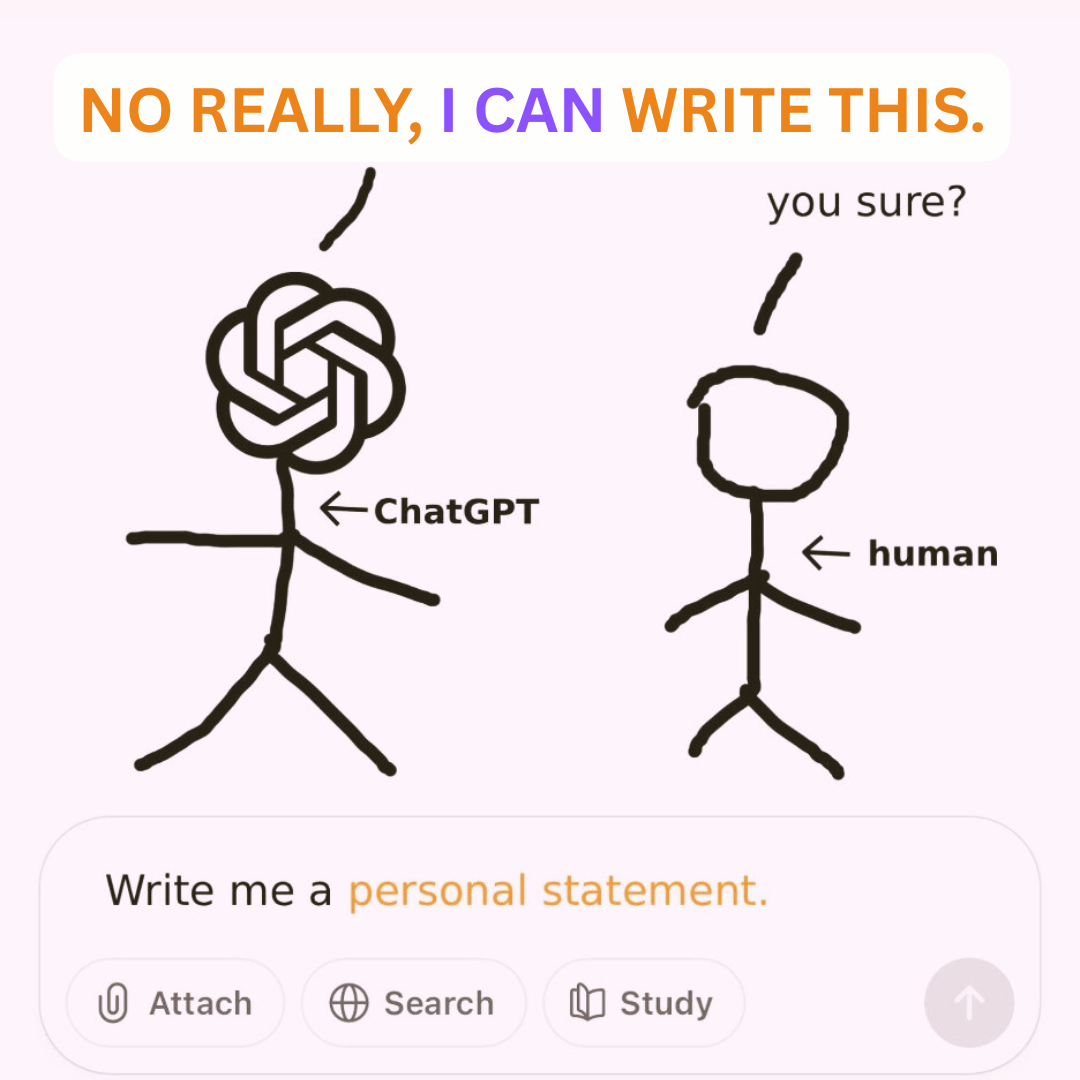
I gave ChatGPT a second chance to make my personal statement more… personal. Here’s how it did.
In our last post, we tested GPT-5, the newest model of ChatGPT, by asking it to produce a personal statement for an imaginary student pursuing Celtic Studies. Here’s a recap:
- We know some universities do allow ChatGPT for brainstorming or drafting outlines, while most ban any use of AI altogether—citing its unfairness.
- We tested the program by uploading a copy of my resume and asking it to generate a personal statement from scratch. We concluded the personal statement it generated was not, well, personal.
Here’s what ChatGPT came up with for my first draft:
Click to view

ChatGPT then offered to sweeten the deal with the following message:

I respond “yes,” and so I got:

ChatGPT personal statement is not enough
ChatGPT’s rewrite is visibly tighter; it packed more information into less words. It’s weightiest in the opening paragraph because it packs in a story about the program I’m applying to, Celtic Studies. Then, it tacks on an “academic “summary” of why I qualify for this program. The paragraphs that follow are shorter because they have less fluff. This is a good idea—you never want to add generic information just to make a paragraph look longer.

True to the prompt, this statement opens in a more personable way—a snappier statement about a specific time in the writer’s life, as a student studying medieval literature. It has a more immediate effect: we’re immediately steeped into the time and place where the writer first fell in love with their proposed study topic. The language is more emotional too: “surprising immediacy” elevates the intensity of the student’s experience with the topic, while “natural home” for “my next chapter of study” turns the student’s life experiences into metaphors.

At the same time, these are metaphors gleaned from the repositories of knowledge that ChatGPT has found throughout the internet—which attests to their overuse. Comparing one’s comfort zone to “home” and life stages to “chapters” has become clichéd at this point; and while they attempt to sound personable, they have the opposite effect because everyone else has used these phrases too.
Another thing that’s interesting: ChatGPT also describes the topics available in Celtic Studies in more detail, when it drops in “bardic satire”—a specific genre unique to the study, which the student would likely only learn when they’re in that program. Rhetorically, flexing what you know about a field of study—including the specific topics you will learn ahead of time—can be wise, showing you’re capable of researching ahead of time. And research skills are crucial to doing well in university. But this opportunity to show knowledge gets lost when ChatGPT fails to elaborate on what “bardic satire” means in the student’s own words. The sentence moves on to describe “layered symbolism” without giving an example of the symbolism or myths that are interesting.
These hollow sentences continue in paragraph two, where the writing hones in on the writer’s experiences. Here, ChatGPT shortens phrasing to emphasize the individual’s contributions. Arguably, this technique brings together the student’s experiences in academic research and coordination more cohesively. It adds the emotional resonance of being “at heart, a translator,” pointing to the underlying premise of all these tasks that make the individual a compelling candidate. The writing is improved, but it at the same time jumps from task to task (supported projects, designed campaigns, coordinated events) without elaboration.

Again, it’s more effective to sit with one or two of those tasks to detail your contribution. For instance, when talking about campaigns designed, sit with that and describe the campaign you launched at work. Did it foreshadow your love for Celtic Studies in any way? Tie it back to the literature, history, or culture that mentioned in the opening paragraph. You could say, for instance, that the campaign drew on your love of literature, when you used, say, a certain motif drawn exclusively from Celtic or even medieval literature and wove that into your campaign. And did this campaign, further, involve skills that you would eventually use in a Humanities studies program: critiquing narratives, employing persuasion techniques, making aesthetic choices, among others?
Human, not ChatGPT:
You could consider telling a story like this:
“My interest in Celtic Studies came from the poetry of William Butler Yeats. His poem, ‘The Lake Isle of Innisfree,’ brought me to the mystical scenery of Lough Gill, Ireland. Yeats contrasted the solitude of Lough Hill with the urban life of nineteenth-century London, finding inner peace in the isolation and mysticism of the island’s shores. At the same time, the layered history of Lough Hill also captured Yeats and thrilled his “deep heart’s core.” In fact, Yeat’s poetry was part of the Celtic Revival, a type of poetry that showed a yearning for mythical places in history. I was inspired to go to the source of Yeat’s fascination, Celtic history and culture itself. This leads me to the Celtic Studies major at ___________ University.
My interest also draws from my volunteering at a history fair at __________School, where I coordinated a few booths and a presentation on medieval times. I made posters with green and pink colour schemes to attract audiences, and also tell stories about how people behaved back then. At the booth, I included snippets of imaginary characters from medieval times who would tell of their experiences, whether they were a knight, a pilgrim, or a farmer. Our expected number of booth visitors actually tripled, because I drew them in with an organized approach, attention to aesthetics, and stories about how older cultures connect to us today. This experience is what informs my decision to pursue Celtic Studies, a program that advocates for a historical culture today.”
This rewritten, more personalized version of the Personal Statement does a few things. It begins with a very specific story about how the student got interested in this topic in the first place. The story is personable, because it’s detailed; and it provides a close reading of the specific text that got them interested. It not only hones in on a specific and personal story, but also foreshadows a skill that the student might learn in this program, close reading: the ability to read and synthesize texts, especially literature from the past. Foreshadowing helps, because it places the student ahead of the curve.
And in the next paragraph, the student draws from a specific volunteering example that shows how their aptitude for the program plays out in real life. Instead of detailing all the jobs or tasks they have accomplished, which they would list on their resume or in an application form anyways, the student elaborates on how one specific example supports their fit for the program. The volunteering experience shows that they had always been interested in some form of medieval (or Celtic) history to begin with; it also shows how they’re interested in the program’s implications for the real world. (Note that I changed my story about supporting research and organizing conferences into running a history fair for students. This simulates realistic work experience for a high schooler.)
As I mentioned in my previous post, uniqueness is what is at stake in personal statements, which aim to distinguish one exceptional candidate from another. And that’s why your statement must be uniquely yours.
Leave a Reply