
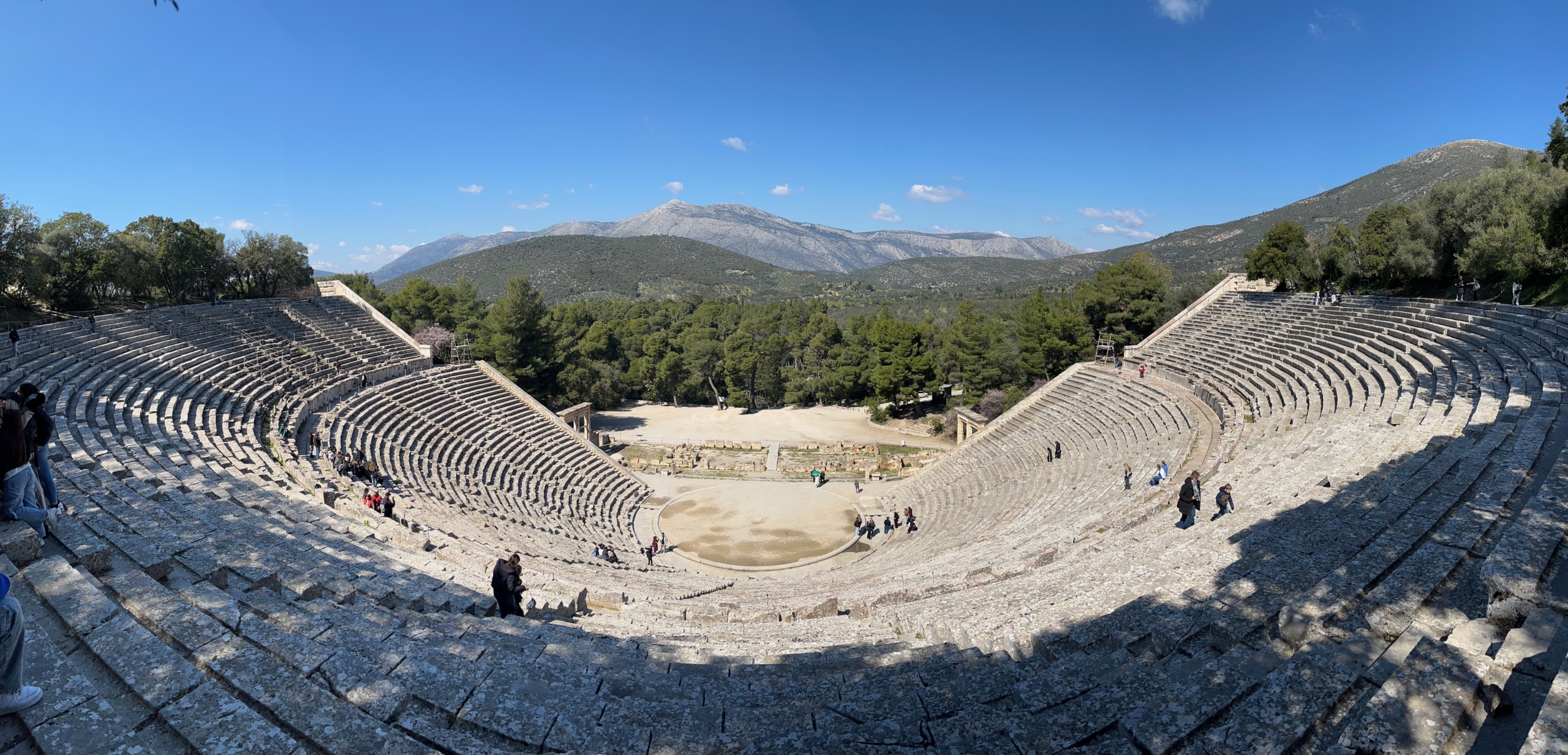
At this ancient Greek theatre, dusty mountains and open skies formed the backdrop for plays that have endured for millennia.
How I travelled to the Theatre of Epidaurus
We’re fans of travelling to famous places in literature, like Elsinore Castle featured in Shakespeare’s Hamlet. But imagine visiting the ancient Greek theatre that arguably gave rise to the tradition we see in Shakespeare, and that decisively shaped his modes of tragedy and comedy. (Although Shakespeare encountered these forms through Roman adaptations, their roots still lie in ancient Greek drama). And finally last year, I had the privilege of visiting one of the most famous theatres from antiquity preserved in Greece.
Known as the Theatre of Epidaurus, this archeological wonder is near the ruins of Mycenae, the bronze-age kingdom that served as the backdrop to Homer’s Iliad. Today, you can access the theatre through the port of Nafplio, or by bus from Athens. I got here via cruise ship, on a discount itinerary to the Greek islands with my mom. We arrived in early March, which an optimal time to visit archeological sites in Greece without the crowds. It’s chilly enough to deter the summer beachgoers, but not too cold for us history geeks! As the afternoon went on, I even felt glad for the wind that kept us cool from the beating sun.


After arriving to port, my mom and l formed a small group tour with another cruise couple that was interested in splitting the cost. We then got a hold of a taxi driver who offered to drive us to some famous sites. (Ours advertised the sites with glossy, high-resolution images of the different sites he could take us: a sign of ethos.)
Due to a tight port time, we asked to see multiple sites together. On the way to the Theatre, we saw the “Treasury of Atreus” or “Tomb of Agamemnon,” the burial mound of a Mycenean-era ruler. We also passed by the archeological site of Mycenae, which contains an acropolis, palace, and tomb from the 12thcentury BCE. Since there is much to say about The Iliad’s presence in these sites, I’ll write about them in a future post.
Greek theatre as medicine and natural setting
The Theatre of Epidaurus was 50 minutes’ drive from the sites of Mycenae. More officially called the Ancient Theatre at the Asklepieion of Epidaurus, it is part of the Sanctuary of Asclepius, who is the Greek god of medicine. It is the best-preserved theatre from ancient Greece and Rome and was built around 340 BCE. About 12,000 spectators, equivalent to a modern concert size, could sit here on a given day.
The site exists in what the ancient Greeks believed to be one of the most famous healing centres, attesting to the importance of theatre in antiquity. Aristotle believed that watching dramatic performances had a positive effect on mental and physical health: this was because the experience of tragedy allowed spectators to undergo catharsis (or purging) of pent-up emotions. Through this purging, the spectator then felt a sense of relief and resolution when the play ended (Poetics 6). In this sense, Greek theatre was nervous-system release.
“The aim of theater – Aristotle said it first, and Aristotle said it best – is to arouse profound emotion in the spectator and through this arousal to effect a catharsis of the soul.” – Joyce Carol Oates


As I walked into the grounds at Epidaurus, I marvelled at how the theatre used the natural world to its potential. While our modern concerts and performances often take place indoors, especially in a cold city like Toronto, the ancient Greek theatre fully integrated with its landscape. The Theatre of Epidaurus was built in the amphitheatre or open-air setting that we associate with famous structures like the Colosseum. Sitting on the side of a naturally sloping hill and semi-circular in nature, it gives all spectators a direct line of site to the centre (or orchestra) where the play takes place.
This setup also allows for phenomenal acoustics. The natural curve of the theatre acts like an echo chamber, carrying sounds from the performers in the orchestra to the audiences at the top. The limestone used to build the theatre seats helps absorb ambient sounds, while allowing the higher frequency of actors’ voices to travel through. Today, visitors to the site can stand in the orchestra and sing or give clap their hands, and listeners at the top can still hear everything.


My mom and I started our exploration in the orchestra. Many school-aged groups passed by, as this was a common field trip spot for high school students. Imagine hanging out at an ancient theatre on a school field trip, which I could only dream of as a Canadian! My mom preferred to stay in the orchestra, but I wanted to wander up the stairs to get a higher view. What would it be like to watch an ancient Greek performance from high up?

Like in a modern stadium, audiences would sit themselves on tiered seats (kerkis) facing the stage. They would also take the stairs (klimakis) along the sides to take their seats.


Greek theatre as extremity, democracy and ethics

The entire theatre opened before me like a gently unfurling fan. I was completely exposed to the sky, reminding me that for the ancient Greeks, mountain tops literally placed one closer to the gods. (That’s why Greek myths imagined Mount Olympus to be the home of the gods, and why temples were built on hilltops to physically place one closer to divinity.)
The sun on my face and line of mountains in the distance commanded awe. In fact, the mountain silhouettes evoked the extreme rise and fall of characters’ fortunes often found in Greek tragedy. Greek tragedy was obsessed with tales of great men (or women) reaching a high point in life, and then plunging downwards after by a quick turn of fate. Tragic figures eventually lapsed into sorrow, madness or even death.
The spare, parched colours of the hills gave a sense of exposure, recalling the purpose of mimicry (or artful imitation of life) that Aristotle also attributes to the arts in general. Aristotle thought that art, more broadly, was a mirror of nature—with nature being the place where the “good” emerged. As such, art revealed truths that were good for us. I elaborate on that philosophy here.

Here are some notable points I learned from Junaid, who has studied and taught ancient Greek theatre:
- Greek plays came from competition. In ancient Athens, lawmakers and citizens competed with one another to sway their audiences into agreement; likewise, playwrights competed with one another during festivals to convince audiences that they wrote the best stories. So, in the many festivals dedicated to the gods in the Greek calendar, dramatic plays became commonplace.
- The most famous plays emerged with the rise of democracy in Athens (5th century BCE). The tension between what individuals believed or voted for, and what the collective deemed appropriate, was a key theme in these plays.
- The historian (and French Resistance fighter during WW2) Jean-Pierre Vernant envisions tragedy as a polarity – think a pendulum swing—between individual and community: between the “the individualised figure […] who is seen as a hero from another age” and “the feelings of the spectators “who make up the civic community” (Myth and Tragedy in Ancient Greece, 1988).
One culture critic has mapped out the similarity between Greek tragedy and what we would recognize today, a typical romantic breakup. Like tragedy, a romantic relationship begins with a spark, and then escalates through an unfolding series of events. But then, realization hits: this partner isn’t who you think they are, and the conditions for loving are shaky. It starts going downhill from here, until you split up with your partner. But this is when catharsis occurs: the breakup releases the tension you’ve held all along, and you can now sigh in relief. You might even learn from the experience, after a period of grieving.

Are we Tragic (or Comedic) heroes?
Ancient Greek plays remain in our cultural memory today, surviving in literature classrooms and scriptwriting seminars. They form the blueprint for our most famous stories in Hollywood and advertising. The violence and sensationalism in these plays rival modern shows like Game of Thrones. As we consider the various plots of these plays, let us ask: what does ancient Greek drama teach us about human nature?
In the tragedy Oedipus Rex (or Oedipus the King) by the Athenian playwright Sophocles, a ruler abandons his baby boy (named Oedipus) due to a chilling prophecy that the boy would eventually grow up to kill his father and marry his mother. As fate would have it, Oedipus finds his way back to his father’s kingdom, accidentally kills his father in a dispute, and becomes the new king. He then marries the widowed queen—whom he does not recognize, until too late, is his own mother.
- Did you know? This story inspired one of the founding ideas of psychoanalysis, a precursor to modern psychology. Psychoanalysis believed that in order for one to become fully individualized, one has to metaphorically “kill” the beliefs of the cultures and institutions they grew up in, and instead form their own way of life. And along the way, this individual will often choose romantic partners based on the first attachment figure they had growing up—their own mother.
- Oedipus also solved enigmatic riddles during his rise to fame. After the death of Oedipus’s father, a sphinx ruled and terrorized the city for some time. All travelers to the city had to solve the sphinx’s riddle, or risk being eaten alive. Oedipus is the only traveler to solve the riddle; that’s how he replaces the sphinx as the city’s ruler.


In Antigone, Sophocles follows up on the family tragedy of Oedipus, concentrating on the king’s daughter. Filled with guilt over his own actions, King Oedipus at first volunteers to leave the city and pass his throne to his two sons, Eteocles and Polynices. However, the two sons kill each other in battle, and the new ruler, Creon, orders that Polynices will lie unburied in the battlefield, as carrion for animals: the worst punishment. In defiance, Antigone steps in to give her brother Polynices the forbidden funeral rites and burial, lifting her individual relationship with him above the king’s law.
For her defiance, Creon condemns Antigone to being buried alive. It is a half-measure punishment, since he doesn’t really want to kill Antigone, but doesn’t want to appear weak before his subjects either.
- Hauntingly, Antigone’s ending seems noble. The chorus—which in Greek plays, was a group of performers that sang, danced, and commented on a scene as it unfolded — sing praises to her, comparing her to the proud queen Niobe from Homer’s Iliad. (Niobe boasted that she had produced more children than the mother of the divine twins, Apollo and Artemis. As punishment, Apollo and Artemis slew all fourteen of Niobe’s children. Niobe was then transformed into a weeping stone figure, which the chorus of Antigone interpret to be a dignified ending: existence in posterity.)
- But Antigone is mostly sorrowful, accusing the chorus of mocking her. Although Creon eventually feels bad enough to try to let her out of her living tomb, he is too late—he arrives to find that Antigone has hanged herself.


On a more cheerful note, ancient Greek plays could also take the form of comedy, a genre that exaggerated character types and featured positive endings. In Lysistrata by Aristophanes, an Athenian woman named Lysistrata rallies other women to engage in a “sex strike” against their men, in order to convince them to end the Peloponnesian War—the ongoing conflict that has plagued their society. After much back-and-forth, and debates about the differences between the natures of men and women, Lysistrata succeeds. The men agree to end their war in order to enjoy sex with their women once more.
- The “clean resolution” is one defining trait of comedy. This is when the original pressures or tensions separating characters from their end goals fall into place, and union becomes possible. Lovers that were separated from one another, or potential lovers skirting around each other throughout the play, end up in heterosexual union or marriage. Compare the Greek comedy to the modern day rom-com: what difficulties had to be overcome, or what pieces had to fall in place, for the protagonists to get together in the end?


Concluding thoughts on Greek Theatre
The experience of visiting the Ancient Theatre at the Asklepieion of Epidaurus left me in awe. I still think about how the theatre stage, surrounded by dramatic landscapes, recalled the rise and fall of narrative tension that shaped Greek plays. The site tangibly showed how theatre mirrored life, reflecting on aesthetics, politics and ethics. And finally, the Greek theatre mapped how individuals and communities fit together. Onstage, the personal will of a character pushes against the expectations of their community, but the audiences watching the play also root together for a memorable ending.
I thank my mom for this unforgettable experience—she was the one who urged me to go on this tour and geek out on Greek history together!

Leave a Reply